
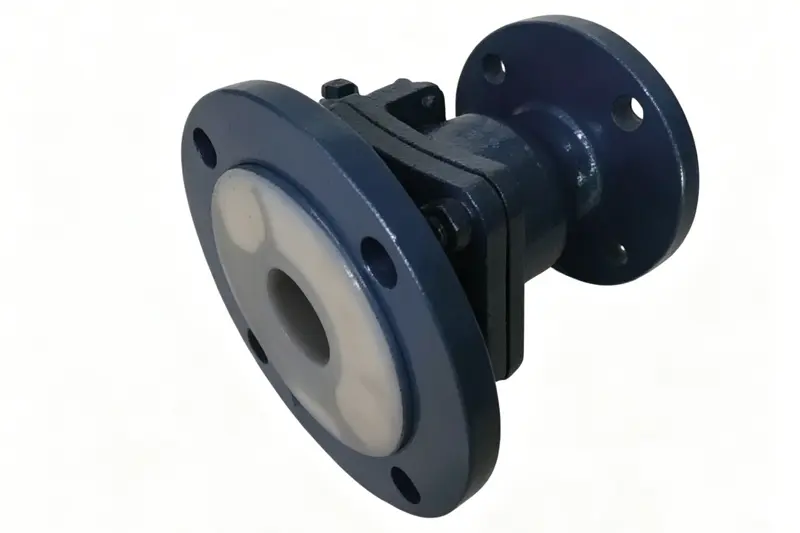
China PTFE-Lined Bottom Discharge Valve Products, Service
Product Description
Core Overview
Specifications & Dimensions
| Parameter | Specification |
|---|---|
| Body Material | WCB Carbon Steel, CF8/CF8M Stainless Steel |
| Lining Material | Virgin PTFE (Polytetrafluoroethylene) |
| Disc/Seat Material | PTFE, Reinforced PTFE |
| Nominal Diameter (DN) | DN25 – DN300 |
| Pressure Rating | PN1.0, PN1.6, PN2.5 MPa |
| Temperature Range | -20°C to +180°C |
| Operation Mode | Manual (Handwheel/Gearbox), Pneumatic, Electric |
| Connection Type | Flange (ANSI, DIN, JIS, GB), Clamp (Sanitary) |
| Leakage Class | ANSI/FCI 70-2 Class VI (Bubble-tight) |
| Flow Direction | Unidirectional (Top to Bottom) |
| Nominal Size (DN) | Length (L) mm | Height (H) mm | Width (W) mm | Flange Diameter (D) mm | Weight (kg) |
|---|---|---|---|---|---|
| DN25 | 160 | 280 | 140 | 115 | 12.0 |
| DN32 | 180 | 310 | 160 | 140 | 16.0 |
| DN40 | 200 | 340 | 180 | 150 | 20.0 |
| DN50 | 230 | 380 | 200 | 165 | 25.0 |
| DN65 | 290 | 430 | 240 | 185 | 32.0 |
| DN80 | 310 | 480 | 280 | 200 | 40.0 |
| DN100 | 350 | 550 | 320 | 220 | 52.0 |
| DN125 | 400 | 620 | 360 | 250 | 68.0 |
| DN150 | 450 | 700 | 400 | 285 | 85.0 |
| DN200 | 550 | 850 | 480 | 340 | 120.0 |
| DN250 | 650 | 1000 | 560 | 395 | 160.0 |
| DN300 | 750 | 1150 | 640 | 445 | 210.0 |
Core Advantages
Streamlined cavity ensures complete drainage, preventing material buildup, bacterial growth, and cross-contamination.
Full PTFE lining withstands harsh chemicals, extending service life and reducing maintenance costs in aggressive environments.
Precision-machined PTFE seat and disc provide reliable shut-off, ensuring zero leakage and process safety.
Non-stick PTFE surface facilitates easy cleaning (CIP/SIP compatible), minimizing downtime and labor requirements.
Compatible with manual, pneumatic, and electric actuators, allowing seamless integration into automated control systems for remote operation.
Frequently Asked Questions (FAQ)
They are designed to handle highly corrosive, abrasive, and high-purity media, including concentrated strong acids (such as sulfuric, hydrochloric, and nitric acids), strong alkalis, and aggressive organic solvents.
The contoured, zero dead space internal cavity eliminates stagnant pockets where materials can settle or crystallize. This ensures complete vessel drainage, prevents bacterial growth, and eliminates batch-to-batch cross-contamination.
The standard operating temperature ranges from -20°C up to +180°C, and pressure ratings are available across PN1.0, PN1.6, and PN2.5 MPa configurations depending on specific engineering specifications.
Yes, the valve can be equipped with pneumatic or electric actuators in addition to standard manual handwheels or gearboxes, supporting remote feedback and seamless DCS/PLC system integration.
The valve incorporates precision-machined PTFE seats and discs that achieve ANSI/FCI 70-2 Class VI bubble-tight shut-off, ensuring completely zero-leakage operation for critical chemical processes.









