
1 / 1
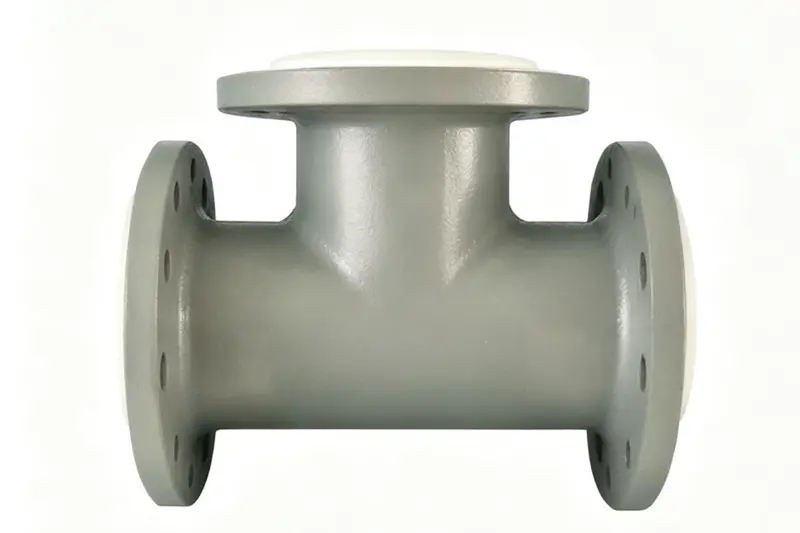
Custom PTFE Lined Tee Factory, Service
Product Description
Core Overview
PTFE Lined Tee is a corrosion-resistant pipe fitting widely used in chemical, pharmaceutical, metallurgical, and environmental protection industries. It features a PTFE lining inside a carbon steel or stainless steel shell, combining the corrosion resistance of PTFE with the mechanical strength of metal, making it ideal for transporting corrosive media such as acids, alkalis, salts, and organic solvents.
Basic Specifications
| Item | Details |
|---|---|
| Product Name | PTFE (Polytetrafluoroethylene) Lined Tee |
| Executive Standards | HG/T 21562, ASME B16.5, GB/T 12224 |
| Nominal Diameter | DN15 – DN300 (1/2" – 12") |
| Pressure Rating | PN10, PN16, PN25, PN40 / Class 150, Class 300 |
| Structure Type | Equal Tee, Reducing Tee |
| Shell Material | Carbon Steel (Q235B, 20#), Stainless Steel (304, 316L) |
| Lining Material | Polytetrafluoroethylene (PTFE) |
| Lining Thickness | 2.0–6.0 mm (Standard: 3.0–4.0 mm) |
| Connection Type | Flanged Connection (RF Raised Face, FM Female Face) |
| Operating Temperature | -20℃ to +180℃ |
| Applicable Medium | Strong acids, strong alkalis, oxits, organic solvents and other highly corrosive media |
| Factory Inspection | Hydrostatic pressure test, Spark pinhole leakage test (5kV) |
| Main Applications | Chemical, petrochemical, pharmaceutical, metallurgy, environmental protection, fluorine chemical, sewage treatment industries |
Typical Dimensions Table
| Nominal Diameter DN | Outer Diameter (mm) | Center-to-End (mm) | Flange Outer Diameter (mm) | Bolt Circle Diameter (mm) | Lining Thickness (mm) |
|---|---|---|---|---|---|
| 15 | 21.3 | 40 | 90 | 60 | 3.0 |
| 20 | 26.9 | 50 | 100 | 70 | 3.0 |
| 25 | 33.7 | 65 | 115 | 80 | 3.5 |
| 32 | 42.4 | 80 | 140 | 100 | 3.5 |
| 40 | 48.3 | 100 | 150 | 110 | 3.5 |
| 50 | 60.3 | 125 | 165 | 125 | 4.0 |
| 65 | 76.1 | 160 | 185 | 145 | 4.0 |
| 80 | 88.9 | 190 | 200 | 160 | 4.0 |
| 100 | 114.3 | 250 | 220 | 180 | 4.5 |
| 125 | 139.7 | 310 | 250 | 210 | 4.5 |
| 150 | 168.3 | 380 | 285 | 240 | 5.0 |
| 200 | 219.1 | 500 | 340 | 295 | 5.5 |
| 250 | 273.0 | 630 | 405 | 355 | 6.0 |
| 300 | 323.9 | 750 | 460 | 410 | 6.0 |
Core Advantages
| Advantage Category | Specific Content |
|---|---|
| Corrosion Resistance | PTFE lining can resist corrosion from most acids, alkalis, and organic solvents, with a corrosion resistance coefficient of up to 0.99. |
| Low Friction | The friction coefficient of PTFE is only 0.04, which reduces the resistance of fluid transportation and saves energy. |
| Temperature Resistance | Can work stably in the temperature range of -200℃ to 260℃, suitable for high and low-temperature environments. |
| Non-Stick Property | The surface of PTFE is non-stick, which prevents medium deposition and facilitates cleaning. |
| Long Service Life | The service life is 3-5 times longer than that of ordinary pipe fittings, reducing maintenance costs. |
Frequently Asked Questions
What types of media are suitable for PTFE lined tees?
PTFE lined tees are designed to transport highly corrosive chemicals including strong acids, strong alkalis, oxidizing agents, and varied organic solvents without degradation.
What is the difference between Equal Tee and Reducing Tee?
An equal tee features three ports of the same nominal diameter, whereas a reducing tee has a smaller branch port compared to the run ports, allowing for branch connection and flow adjustments.
How is product quality ensured before factory dispatch?
Each unit undergoes strict testing, including standard hydrostatic pressure tests and a 5kV spark pinhole leakage test to ensure complete lining integrity and zero pinhole defects.
What are the standard shell materials available?
The outer shell is typically made from Carbon Steel (such as Q235B, 20#) or Stainless Steel (such as 304, 316L), offering strong mechanical resistance depending on the external environmental requirements.
How does the low friction coefficient benefit the piping system?
With a friction coefficient of approximately 0.04, PTFE minimizes pipeline flow drag, improves fluid transportation efficiency, reduces energy loss, and prevents media buildup due to its non-stick properties.









