
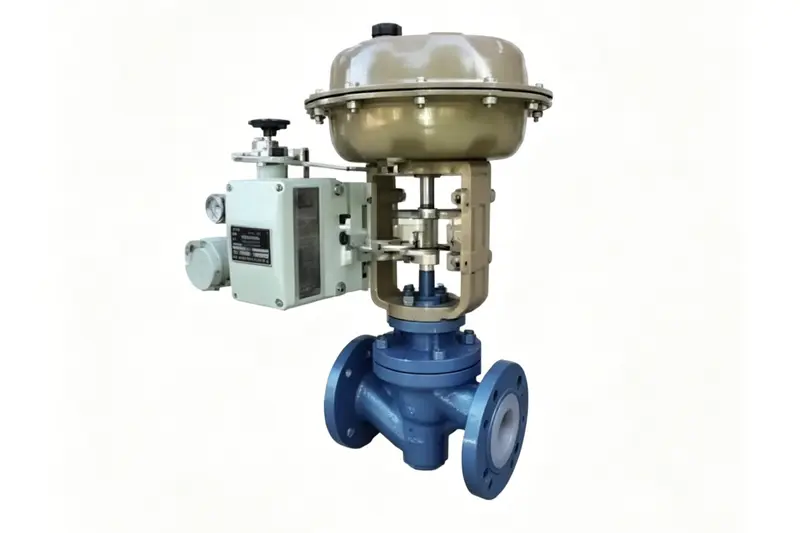
Custom PTFE-Lined Control Valve Product, Service
Product Description
Core Overview
Specifications & Dimensions
| Parameter | Specification |
|---|---|
| Body Material | WCB Carbon Steel, CF8/CF8M Stainless Steel |
| Lining/Trim Material | Virgin PTFE, PFA (Perfluoroalkoxy) |
| Valve Type | Globe, Angle, Sleeve (Customizable) |
| Actuator Type | Pneumatic Diaphragm, Electric Motor |
| Nominal Diameter (DN) | DN15 – DN300 |
| Pressure Rating | PN1.0, PN1.6, PN2.5, Class 150/300 |
| Temperature Range | -20°C to +180°C (PTFE), up to +200°C (PFA) |
| Leakage Class | ANSI/FCI 70-2 Class IV, V, or VI |
| Flow Characteristic | Linear, Equal Percentage, Quick Opening |
| Connection Type | Flange (ANSI, DIN, JIS, GB), Wafer |
| Nominal Size (DN) | Face-to-Face Length (L) mm | Height (H) mm | Width (W) mm | Flange Diameter (D) mm | Weight (kg) |
|---|---|---|---|---|---|
| DN15 | 130 | 350 | 120 | 95 | 6.5 |
| DN20 | 150 | 380 | 130 | 105 | 8.0 |
| DN25 | 160 | 410 | 140 | 115 | 10.5 |
| DN32 | 180 | 450 | 160 | 140 | 14.0 |
| DN40 | 200 | 490 | 180 | 150 | 18.5 |
| DN50 | 230 | 540 | 200 | 165 | 24.0 |
| DN65 | 290 | 600 | 240 | 185 | 32.0 |
| DN80 | 310 | 660 | 280 | 200 | 42.0 |
| DN100 | 350 | 750 | 320 | 220 | 58.0 |
| DN150 | 450 | 900 | 400 | 285 | 95.0 |
| DN200 | 550 | 1050 | 480 | 340 | 140.0 |
Core Advantages
Superior Corrosion Resistance
Full PTFE lining withstands strong acids, alkalis, and solvents, ensuring long-term integrity in harsh chemical environments.
Precise Flow Control
High-resolution actuator and optimized trim design provide accurate modulation for stable process control.
Zero Leakage Performance
Tight sealing mechanisms and soft-seat options achieve bubble-tight shut-off, preventing media loss and contamination.
Low Friction & Anti-Clogging
Smooth PTFE surface reduces fluid resistance and prevents material buildup, ideal for slurry or viscous media.
Versatile Actuation Options
Compatible with various pneumatic and electric actuators, allowing seamless integration into automated control systems (DCS/PLC).
Frequently Asked Questions (FAQ)
They are specifically developed for aggressive chemical environments involving strong acids, concentrated alkalis, corrosive solvents, and abrasive slurries where metallic surfaces would quickly corrode.
Virgin PTFE operates reliably in temperatures ranging from -20°C up to +180°C. For applications requiring higher thermal tolerance, PFA lining is available to safely support temperatures reaching +200°C.
Yes. They are fully compatible with both pneumatic diaphragm and electric motor actuators, allowing seamless connection to distributed control systems (DCS) and programmable logic controllers (PLC).
Depending on trim selection and application demands, these valves comply with ANSI/FCI 70-2 Class IV, Class V, or Class VI standards, offering bubble-tight shut-off capabilities.
The valves can be manufactured to connect with multiple international standards, including ANSI, DIN, JIS, and GB flange styles, as well as wafer-style connections.









