
1 / 1
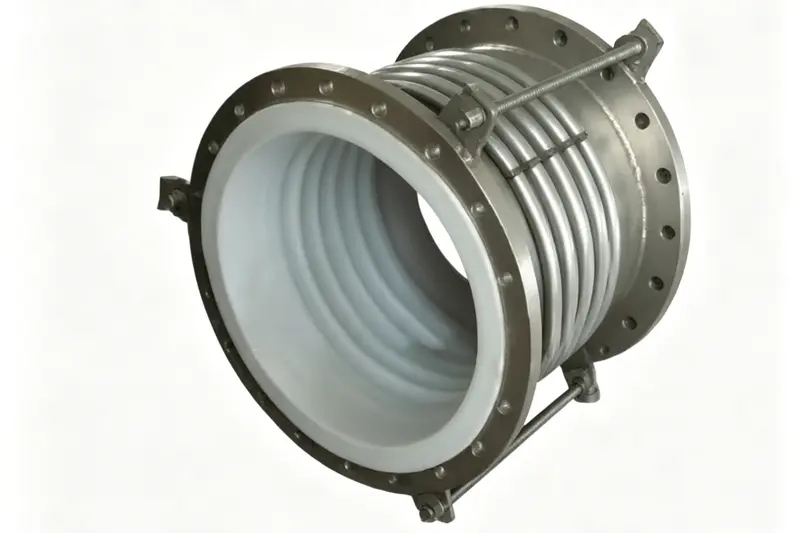
China PTFE-Lined Expansion Joint Product, Products
Product Description
Core Overview
PTFE-lined expansion joints, also known as fluoroplastic bellows compensators, are critical components designed to absorb thermal expansion, vibration, and mechanical movement in piping systems handling highly corrosive media. Constructed with a multi-layered PTFE bellows core reinforced by stainless steel wire mesh or outer rings, and flanged with carbon or stainless steel, these joints provide an impermeable barrier against aggressive chemicals. They are extensively used in chemical processing, pharmaceutical manufacturing, and power generation industries where standard metal bellows would fail due to corrosion. The unique design ensures flexibility while maintaining the structural integrity required for high-pressure and vacuum applications.
Basic Specifications
| Item | Details |
| Product Name | PTFE (Polytetrafluoroethylene) Lined Expansion Joint (Compensator) |
| Executive Standards | HG/T 21562, ASME B16.5, GB/T 12224, GB/T 12777 |
| Nominal Diameter | DN15 – DN300 (1/2" – 12") |
| Pressure Rating | PN10, PN16, PN25, PN40 / Class 150, Class 300 |
| Structure Type | Axial type, Lateral type, Angular type, Universal type (with limit device optional) |
| Shell & Bellows Material | Carbon Steel (Q235B, 20#), Stainless Steel (304, 316L) |
| Lining Material | Polytetrafluoroethylene (PTFE), PFA optional for high temperature requirements |
| Lining Thickness | 2.0–6.0 mm (Standard: 3.0–4.0 mm) |
| Connection Type | Flanged Connection (RF Raised Face), Welded connection optional |
| Operating Temperature | -20℃ to +180℃ (-4°F to +356°F) |
| Core Performance | Absorb thermal expansion & contraction, pipeline displacement, mechanical vibration; reduce noise and pipeline stress |
| Applicable Medium | Strong acids, strong alkalis, strong oxits, organic solvents and other highly corrosive media |
| Factory Inspection | Hydrostatic pressure test, Spark pinhole leakage test (5kV), Air tightness test, Cycle fatigue test |
| Main Applications | Chemical industry, petrochemical, pharmaceutical, metallurgy, environmental protection, fluorine chemical, sewage treatment industries |
Typical Dimensions Table
| Nominal Diameter DN | Bellows Outer Diameter (mm) | Free Length (mm) | Max Axial Compensation (mm) | Flange Outer Diameter (mm) | Bolt Circle Diameter (mm) | Lining Thickness (mm) |
| 15 | 24 | 120 | ±6 | 90 | 60 | 3.0 |
| 20 | 30 | 130 | ±7 | 100 | 70 | 3.0 |
| 25 | 38 | 140 | ±8 | 115 | 80 | 3.5 |
| 32 | 48 | 150 | ±9 | 140 | 100 | 3.5 |
| 40 | 58 | 160 | ±10 | 150 | 110 | 3.5 |
| 50 | 70 | 180 | ±12 | 165 | 125 | 4.0 |
| 65 | 86 | 200 | ±15 | 185 | 145 | 4.0 |
| 80 | 102 | 220 | ±18 | 200 | 160 | 4.0 |
| 100 | 120 | 240 | ±20 | 220 | 180 | 4.5 |
| 125 | 148 | 270 | ±22 | 250 | 210 | 4.5 |
| 150 | 180 | 300 | ±25 | 285 | 240 | 5.0 |
| 200 | 240 | 350 | ±30 | 340 | 295 | 5.5 |
| 250 | 300 | 400 | ±35 | 405 | 355 | 6.0 |
| 300 | 360 | 450 | ±40 | 460 | 410 | 6.0 |
Core Advantages
| Advantage | Description |
| Exceptional Chemical Resistance | Inert to almost all industrial acids, alkalis, and solvents, ensuring long-term durability in harsh environments. |
| High Flexibility & Movement Absorption | Effectively absorbs axial, lateral, and angular movements, reducing stress on connected piping and equipment. |
| Vacuum & Pressure Stability | Reinforced structure prevents bellows collapse under full vacuum and withstands significant positive pressure. |
| Low Friction & Non-Adhesive | Smooth PTFE surface prevents material buildup and scaling, maintaining consistent flow rates and reducing maintenance. |
| Thermal Insulation Properties | PTFE’s low thermal conductivity helps minimize heat loss or gain in sensitive process lines. |
Frequently Asked Questions
What makes PTFE-lined expansion joints suitable for highly corrosive media?
PTFE is chemically inert to virtually all industrial chemicals, strong acids, strong alkalis, and organic solvents. The seamless liner forms an impermeable barrier that completely shields metal components from chemical attack.
What is the standard operating temperature range for these expansion joints?
Standard PTFE-lined expansion joints operate effectively within a temperature range of -20°C to +180°C (-4°F to +356°F). PFA lining can be selected for specialized applications requiring higher thermal tolerance.
How does the design prevent bellows collapse during vacuum conditions?
The multi-layer bellows structure is reinforced externally with stainless steel wire mesh or external root rings, maintaining cross-sectional geometry and preventing collapse under negative pressure or full vacuum.
What quality and safety tests are performed prior to shipment?
Every joint undergoes strict factory inspections including a 5kV spark pinhole leakage test to ensure liner integrity, hydrostatic pressure tests, air tightness tests, and cycle fatigue tests according to international standards.
Can these expansion joints handle simultaneous axial and lateral movements?
Yes, depending on the structure type chosen (axial, lateral, angular, or universal), the flexible multi-convolution PTFE bellows can simultaneously absorb multi-directional movements, thermal shifts, and mechanical vibrations.









