
1 / 1
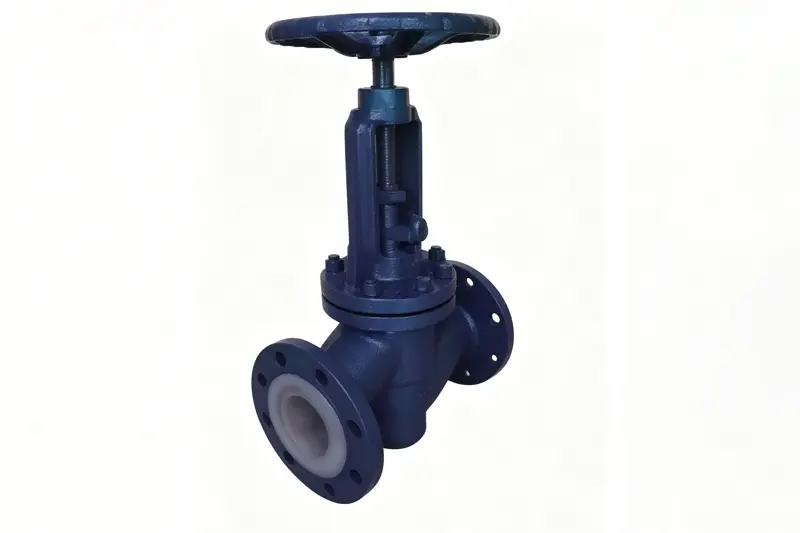
China PTFE-Lined Globe Valve Product, Service
Product Description
Core Overview
The PTFE-lined globe valve is a precision flow control device engineered for severe service applications involving highly corrosive and abrasive media. Featuring a robust cast steel or stainless steel body with a seamless virgin PTFE lining, it provides complete metal isolation from aggressive fluids like strong acids, alkalis, and solvents. Its linear motion stem design allows for precise throttling and reliable shut-off, making it ideal for chemical processing, pharmaceutical manufacturing, power generation, and wastewater treatment industries where process control and leak prevention are critical.
Specifications & Dimensions
Technical Parameters
| Parameter | Specification |
|---|---|
| Body Material | WCB Carbon Steel, CF8/CF8M Stainless Steel |
| Lining Material | Virgin PTFE (Polytetrafluoroethylene) |
| Disc/Seat Material | PTFE, Reinforced PTFE, PFA |
| Nominal Diameter (DN) | DN15 – DN200 |
| Pressure Rating | PN1.6, PN2.5, PN4.0 MPa; Class 150/300 |
| Temperature Range | -20°C to +180°C (PTFE), up to +200°C (PFA) |
| Operation Type | Manual (Handwheel), Pneumatic, Electric |
| Connection Type | Flange (ANSI, DIN, JIS, GB), Threaded |
| Leakage Class | ANSI/FCI 70-2 Class IV, V, or VI |
| Flow Direction | Typically flow under the seat (Standard) |
Dimensional Data Table (Flanged End)
| Nominal Size (DN) | Face-to-Face Length (L) mm | Height (H) mm | Width (W) mm | Flange Diameter (D) mm | Weight (kg) |
|---|---|---|---|---|---|
| DN15 | 130 | 200 | 120 | 95 | 4.5 |
| DN20 | 150 | 220 | 130 | 105 | 6.0 |
| DN25 | 160 | 240 | 140 | 115 | 8.0 |
| DN32 | 180 | 260 | 160 | 140 | 11.0 |
| DN40 | 200 | 280 | 180 | 150 | 14.0 |
| DN50 | 230 | 300 | 200 | 165 | 18.0 |
| DN65 | 290 | 350 | 240 | 185 | 25.0 |
| DN80 | 310 | 380 | 280 | 200 | 32.0 |
| DN100 | 350 | 420 | 320 | 220 | 45.0 |
| DN150 | 480 | 550 | 400 | 285 | 75.0 |
| DN200 | 600 | 680 | 480 | 340 | 115.0 |
Core Advantages
Superior Corrosion Resistance
Full PTFE lining withstands aggressive chemicals, ensuring long-term durability and preventing contamination.
Precise Flow Control
Linear stem motion provides excellent throttling capability and fine flow regulation for process optimization.
Bubble-Tight Shut-Off
Precision-machined PTFE seat and disc ensure zero leakage, enhancing process safety and environmental protection.
Low Maintenance
Non-stick PTFE surfaces prevent scaling and buildup, reducing maintenance frequency and operational downtime.
Versatile Actuation
Compatible with manual, pneumatic, and electric actuators, allowing easy integration into automated control systems.
Frequently Asked Questions
What media can a PTFE-lined globe valve handle?
It is specifically engineered to handle highly corrosive and aggressive media, including strong acids (such as sulfuric, hydrochloric, and nitric acids), strong alkalis, toxic chemicals, and harsh industrial solvents.
What is the operating temperature and pressure limit?
The valve operates reliably within a temperature range of -20°C to +180°C with virgin PTFE (and up to +200°C when configured with PFA). Pressure ratings span PN1.6, PN2.5, PN4.0 MPa, as well as ASME Class 150/300.
Why choose a globe valve design for throttling rather than a ball valve?
The linear stem motion of a globe valve allows precise and proportional throttling control, making it much more suitable for fine flow regulation and sensitive process control where exact flow rates must be maintained.
What actuation options are compatible with these valves?
The valve can be configured for manual operation with a handwheel, or automated with pneumatic and electric actuators to allow seamless integration into centralized DCS or automated control loops.
What connection standards are supported?
Standard connections include flanged ends conforming to ANSI, DIN, JIS, and GB standards, as well as threaded connection options depending on pipe sizing and installation requirements.









