
1 / 1
Custom PTFE-Lined Ball Valve Factory, Product
Product Description
Core Overview
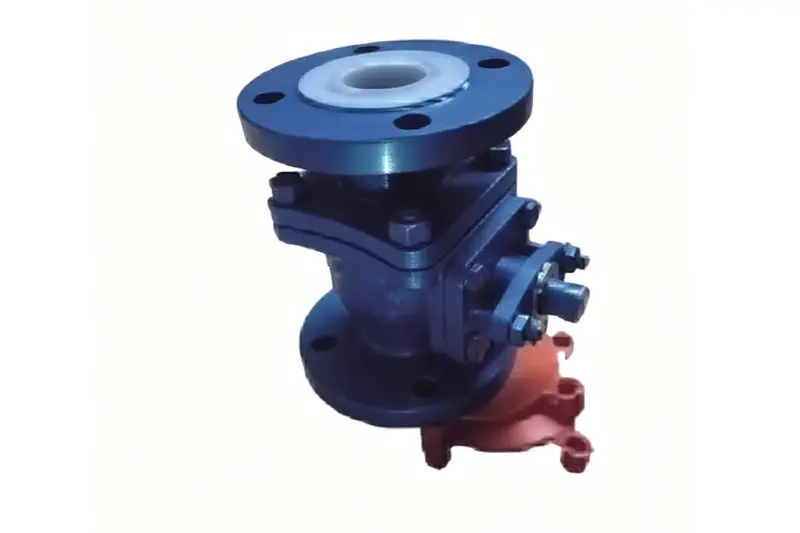
The PTFE-lined ball valve is a high-performance quarter-turn shut-off valve designed for handling highly corrosive and abrasive media in industrial pipelines. Constructed with a robust cast steel or stainless steel body fully lined with virgin Polytetrafluoroethylene (PTFE), it ensures complete isolation of metal components from aggressive fluids such as strong acids, alkalis, and organic solvents. The valve features a PTFE-encapsulated ball and reinforced PTFE seats, providing excellent sealing and low operating torque. It is widely used in chemical processing, pharmaceutical manufacturing, water treatment, and power generation industries where reliability, corrosion resistance, and zero leakage are critical.
Specifications & Dimensions
Technical Parameters
| Parameter | Specification |
|---|---|
| Body Material | WCB Carbon Steel, CF8/CF8M Stainless Steel |
| Lining/Ball Material | Virgin PTFE (Polytetrafluoroethylene) |
| Seat Material | Reinforced PTFE, PFA (Optional) |
| Nominal Diameter (DN) | DN15 – DN300 |
| Pressure Rating | PN1.6, PN2.5, PN4.0 MPa; Class 150/300 |
| Temperature Range | -20°C to +180°C |
| Operation Type | Manual (Handle/Gearbox), Pneumatic, Electric |
| Connection Type | Flange (ANSI, DIN, JIS, GB), Threaded (NPT/BSP) |
| Leakage Class | ANSI/FCI 70-2 Class VI (Bubble-tight) |
| Flow Characteristic | On-Off (Full Bore or Reduced Bore) |
Dimensional Data Table (Flanged End)
| Nominal Size (DN) | Face-to-Face (L) mm | Height (H) mm | Width (W) mm | Flange Diameter (D) mm | Weight (kg) |
|---|---|---|---|---|---|
| DN15 | 130 | 200 | 120 | 95 | 5.5 |
| DN20 | 150 | 220 | 130 | 105 | 7.0 |
| DN25 | 160 | 240 | 140 | 115 | 9.0 |
| DN32 | 180 | 260 | 160 | 140 | 12.0 |
| DN40 | 200 | 280 | 180 | 150 | 15.0 |
| DN50 | 230 | 300 | 200 | 165 | 20.0 |
| DN65 | 290 | 350 | 240 | 185 | 28.0 |
| DN80 | 310 | 380 | 280 | 200 | 35.0 |
| DN100 | 350 | 420 | 320 | 220 | 48.0 |
| DN150 | 480 | 550 | 400 | 285 | 80.0 |
| DN200 | 600 | 680 | 480 | 340 | 125.0 |
| DN250 | 730 | 800 | 560 | 395 | 160.0 |
| DN300 | 850 | 950 | 640 | 445 | 210.0 |
Core Advantages
| Advantage | Description |
|---|---|
| Superior Corrosion Resistance | Full PTFE lining protects against virtually all industrial chemicals, ensuring long-term durability in harsh environments. |
| Zero Leakage Performance | Precision-machined PTFE seats and encapsulated ball provide bubble-tight shut-off, preventing media loss and contamination. |
| Low Operating Torque | The low friction coefficient of PTFE reduces wear on the stem and actuator, enabling smooth operation and extended service life. |
| Full-Bore Flow Design | Minimizes pressure drop and prevents material buildup, ideal for slurries and viscous fluids. |
| Versatile Actuation Options | Compatible with manual, pneumatic, and electric actuators, allowing seamless integration into automated control systems. |
Frequently Asked Questions
What media are PTFE-lined ball valves suitable for?
They are ideal for handling highly aggressive media, including strong acids, alkalis, corrosive salts, organic solvents, and toxic fluids commonly found in chemical and pharmaceutical plants.
What is the maximum operating temperature for these valves?
The standard operating temperature range for virgin PTFE-lined ball valves is from -20°C up to +180°C, depending on the working pressure and specific line conditions.
How is zero-leakage achieved in this design?
Zero leakage (ANSI/FCI 70-2 Class VI bubble-tight shut-off) is achieved via the combination of precision-machined PTFE seats and a seamless PTFE-encapsulated ball that ensures uniform sealing contact.
Can these valves be automated?
Yes. They feature a low operating torque design and can be easily configured with ISO 5211 mounting pads for direct coupling with pneumatic or electric actuators.
What connection types and flange standards are available?
Standard connection types include flanged ends conforming to ANSI, DIN, JIS, and GB standards, as well as threaded (NPT/BSP) options for smaller nominal sizes.









